What Are Types of Beef Cowds
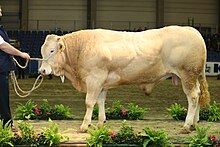
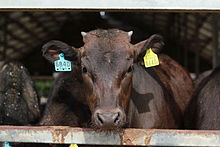
Beef cattle are cattle raised for meat production (every bit distinguished from dairy cattle, used for milk product). The meat of mature or almost mature cattle is mostly known as beef. In beef production in that location are three primary stages: cow-calf operations, backgrounding, and feedlot operations. The production cycle of the animals outset at moo-cow-calf operations; this performance is designed specifically to breed cows for their offspring. From hither the calves are backgrounded for a feedlot. Animals grown specifically for the feedlot are known as feeder cattle, the goal of these animals is fattening. Animals not grown for a feedlot are typically female person and are commonly known as replacement heifers. While the principal apply of beef cattle is meat product, other uses include leather, and beef past-products used in candy, shampoo, cosmetics, and insulin.
Calving and breeding [edit]
Also breeding to meet the demand for beef production, owners also use selective breeding to attain specific traits in their beefiness cattle. An case of a desired trait could be leaner meat[ane] or resistance to illness.[2] Breeds known every bit dual-purpose are also used for beef production. These breeds have been selected for two purposes at once, such as both beef and dairy production, or both beef and draught. Dual-purpose breeds include many of the Zebu breeds of Republic of india such as Tharparkar and Ongole Cattle. There are multiple continental breeds that were bred for this purpose also. The original Simmental/Fleckvieh from Switzerland is a prime number example. Not only are they a dual-purpose breed for beef and dairy, but in the past they were also used for draught. Even so, throughout the generations, the breed has diverged into two groups through selective convenance.[3]
Most beef cattle are mated naturally, whereby a bull is released into a cowherd approximately 55 days afterward the calving menses, depending on the cows' body condition score (BCS). If it was a cow's outset time calving, she will take longer to re-breed by at to the lowest degree 10 days.[4] Nonetheless, beefiness cattle tin also be bred through bogus insemination,[one] depending on the moo-cow and the size of the herd. Cattle are normally bred during the summertime so that calving may occur the following spring.[i] However, cattle breeding can occur at other times of twelvemonth. Depending on the operation, calving may occur all yr circular. Owners tin select the convenance time based on a number of factors, including reproductive performance, seasonal cattle pricing and treatment facilities.[ane]
There are many factors that come into play when selecting for a balderdash. Some of the most important factors are disease prevention/spread. Ownership a bull who hasn't been tested for common diseases is a risk, it would more than likely transmit to a whole herd. Purchasing genetics that will improve the original herd rather than remaining the same or decreasing. Some brood for mothering abilities, some for size, some for meat backdrop, etc. Breeding Soundness Examination or BSE are essential to the quality of any bull, a general physical exam and inspection of both the genital organs and their productivity.[5] Knowing more data virtually the animal volition help make an educated decision.
Cattle maintenance [edit]
Cattle handlers are expected to maintain a low stress environment for their herds, involving constant rubber, wellness, condolement, nourishment and humane handling. According to the Canadian National Subcontract Animal Intendance Council, beefiness cattle must have access to shelter from extreme weather, rubber handling and equipment, veterinary care and humane slaughter.[vi] If an animal is infected or suspected to have an affliction, it is the responsibility of the owners to report it immediately to a practicing veterinarian for either treatment or euthanasia.[7] Depending on a multitude of factors (season, type of production system, stocking density, etc.), illness and disease tin can spread quickly through the herd from animal to animal.[8] Owners are expected to monitor their cattle'southward condition regularly for early detection and treatment, as some cattle illnesses can threaten both cattle and human health (known as zoonotic)[half-dozen] as witnessed with Mad moo-cow disease and Tuberculosis.
On boilerplate, cattle will consume 1.iv to 4% of their body weight daily.[9] There are a range of types of feed available for these animals. The standard text in the United States, Nutrient Requirements of Beef Cattle, has been through 8 editions over at least 70 years.[10] The 1996 seventh edition substituted the concept of metabolizeable poly peptide for the sixth edition's crude protein.[xi] [12] In the 20th century, Canadian practise followed the American guidance.[xiii] Already in 1970, the Nutrient and Drug Administration was regulating pharmaceutical supplements in beef cattle feed such every bit hormones and prophylactic antibiotics.[14]
Some animals live on pasture their entire lives and therefore only experience fresh grass, these are typically cow-dogie operations in more than tropical climates. Backgrounded calves and feedlot animals tend to have unlike diets that incorporate more grain than the pasture type. Grain is more expensive than pasture but the animals grow faster with the higher protein levels. Since cattle are herbivores and need roughage in their diet, silage, hay and/or haylage are all viable feed options.[15] Despite this three/4th of the 32 pounds (14.52 kg) of feed cattle consume each twenty-four hours volition be corn.[16] Cattle weighing 1000 lbs. will drink an average of 41 L a twenty-four hour period, and approximately 82 L in hot weather.[17] They need a constant supply of good quality feed and drink h2o according to the v Freedoms of Beast Welfare.[18]
Nearly Beefiness cattle are finished in feedlots. The start feedlots were constructed in the early 1950s. Some of these feedlots grew so large they warranted a new designation, "Concentrated Animal Feeding Performance" (CAFO). Nigh American beef cattle spend the last half of their lives in a CAFO.[16]
Cattle processing [edit]
A steer that weighs 1,000 lb (450 kg) when live makes a carcass weighing approximately 615 lb (280 kg), once the claret, head, feet, skin, offal and guts are removed. The carcass is and so hung in a common cold room for between one and iv weeks, during which time it loses some weight equally water dries from the meat. It is and so deboned and cut by a butcher or packing house, the carcass would make about 430 lb (200 kg) of beef.[xix] Depending on what cuts of meat are desired, there is a scale of marbled meat used to determine the quality. Marbling is the fat that is within the muscle, not around it. The more marbled a cut is, the college it volition grade and be worth more.[20]
Slaughtering of livestock has iii singled-out stages: preslaughter treatment, stunning and slaughtering. The biggest business organization is preslaughter treatment, how the fauna is treated earlier it is stunned and slaughtered. Stress at this time tin can cause agin effects on the meat, water access and lower stocking densities accept been allowed to minimize this. However, admission to feed is restricted for 12–24 hours prior to slaughtering for ease of evisceration. Stunning is washed when the beast is restrained in a chute so move is limited. Once restrained the animate being tin can exist stunned in one of three methods: penetrating convict bolt, non-penetrating captive bolt and gunshot. Most abattoirs apply captive bolts over guns. Stunning ensures the animal feels no pain during slaughtering and reduces the animals stress, therefore increasing the quality of meat. The last step is slaughtering, typically the creature will be hung past its back leg and its throat will exist slit to allow exsanguination. The hide will be removed for farther processing at this point and the animal volition be cleaved downwardly with evisceration and decapitation. The carcass will be placed in a cooler for 24–48 hours prior to meat cutting.[21]
Breeds [edit]
| Breed | Origin | Description |
|---|---|---|
| Adaptaur | Australia | A tropically adapted Bos taurus breed, adult from crosses between Herefords and Shorthorns. |
| Afrikaner cattle | Southward Africa | Afrikaners are ordinarily deep ruby-red or blackness with long spreading horns. They take the small cervico-thoracic hump typical of Sanga cattle. |
| Aberdeen Angus | Scotland | Pure black, sometimes with white at udder. Polled. Hardy and thrifty. |
| Australian Braford | Australia | Developed for resistance to ticks and for oestrus tolerance by crossing Brahmans and Herefords. |
| Australian Brangus | Australia | Polled breed developed past crossing Angus and Brahman |
| Australian Charbray | Australia | Developed by crossing Charolais and Brahman and selected for resistance to heat, humidity, parasites and diseases. |
| Barzona | U.s.a. (Arizona) | Developed in the loftier desert, inter-mountain region of Arizona. |
| Beefalo | Us | Hybrid between a cow and an American bison. |
| Beef Shorthorn | England and Scotland | Suitable for both dairy and beef. |
| Beefmaster | United States (Texas) | Developed by breeding the Brahman, Shorthorn, and Hereford. |
| Belgian Blue | Belgium | Gray roan, or white with grey on head. Extremely muscular (double muscled). Fast-growing if well-fed. |
| Belmont Red | Australia | A composite breed using Africander (African Sanga) and Hereford-Shorthorn |
| Belted Galloway | Scotland | Black with white band around middle, stocky, fairly long hair, polled. Very hardy and thrifty. |
| Blackness Hereford | Nifty Great britain | A crossbreed produced by crossing a Hereford bull with Holstein or Friesian cows; used to obtain beef offspring from dairy cows. Not maintained as a separate breed, although females may exist used for farther convenance with other beef bulls. |
| Blonde d'Aquitaine | France | Stake chocolate-brown, paler circular optics and nose. Muscular. Fast-growing if well-fed. |
| Bonsmara | South Africa | Adult from 10/16 Afrikaner, 3/16 Hereford and 3/16 Shorthorn cattle. |
| Boran | East Africa (Ethiopia-Republic of kenya) | Usually white, with the bulls beingness darker (sometimes almost black). |
| Brahman | India | Large, pendulous ears and dewlaps, hump over the shoulders. |
| Brangus | United States | Developed by crossing Angus and Brahman. |
| British White | Great United kingdom | White body, with blackness (or sometimes cherry-red) ears, nose and feet; polled (hornless). Hardy and thrifty. |
| Caracu | Brazil | |
| Charolais | France | Wholly white or cream, lyre-shaped pale horns, or polled. Fast-growing if well-fed. |
| Chianina | Italy | Dual-purpose, originally large draft brood, later selected for beef. |
| Corriente | Mexico | Hardy, small, athletic, criollo-type, descended from Iberian cattle. Used in rodeo sports, noted for lean meat. Brusk horns, various colors, oftentimes spotted. Also called Criollo or Chinampo. |
| Crioulo Lageano | Iberian Peninsula | 400-twelvemonth-sometime longhorn breed with around 700 individuals that live close to the plateau of Lages, Santa Catarina, Brazil. |
| Dairy Shorthorn | United Kingdom | Suitable for both dairy and beef. |
| Dexter | Ireland | Very small, black or dun, dark horns. Sometimes has a dwarfing cistron, leading to very short legs. Hardy and thrifty. |
| Droughtmaster | Australia | Developed by crossing Brahman cattle with taurine breeds, peculiarly the Beef Shorthorn. Tolerant of heat and ticks. |
| English language Longhorn | England | Crimson or brindle, with white back and abdomen. Very long cylindrical horns normally spreading sideways or downward, often curving and even somewhen making a circle. Medium size, hardy. |
| Fleckvieh | Switzerland | Red pied or solid red, polled or horned. Sturdy dual-purpose for beef and dairy. Formerly triple-purpose (beef, dairy and draught). Fast-growing if well-fed. |
| Florida Cracker cattle | United States | Minor, criollo-type descended from cattle brought to the Southern U.S. by the Spanish conquistadors. Adapted to subtropical climate, parasite-resistant. An endangered breed. |
| Galloway | Scotland | Blackness, stocky, adequately long hair, polled. Very hardy and thrifty. |
| Gascon cattle | France | Grey, hardy, maternal brood. Practiced growth and conformation of calves. Suitable for all farming systems, bred pure or crossed with a final sire. |
| Gelbvieh | Germany | Red, stiff skin pigmentation, polled. Superior fertility, calving ease, mothering ability, and growth rate of calves.[22] |
| Hanwoo | Korea | |
| Hérens | Switzerland | |
| Hereford | England | Red, white caput, white finching on cervix, and white switch. |
| Highland | Scotland | Pocket-size, stocky; black, red, dun or white. Very long coat and very long stake horns, upswept in cows and steers. Very hardy and thrifty. |
| Hungarian Grey | Republic of hungary | Robust, like shooting fish in a barrel-calving and long-lived. Horns long, curved and directed upward. Slender and tall. Well-adapted to all-encompassing pasture systems. |
| Irish Moiled | Republic of ireland | Red with white dorsum and belly, or white with red ears, nose and anxiety. Polled. Hardy and thrifty. |
| Jabres | Central Java, Indonesia | Colors varied from light brown to dark brown with a black stripe spans from back to tail. |
| Japanese Shorthorn | Japan | A breed of small beef cattle. |
| Limousin | Limousin and Marche regions of France | Mid-brown, paler circular eyes and nose. Fast-growing if well-fed. |
| Lincoln Red | England | |
| Lowline | Commonwealth of australia | Developed past selectively breeding small Angus cattle. |
| Luing | Luing and surrounding Inner Hebrides, Scotland | Rough coat, red-brown, polled. Bred by crossing Beef Shorthorn with Highland. Very hardy and thrifty. |
| Madurese | East Java, Indonesia | Pocket-size body, brusk legs, ruby-red yellow hair. |
| Maine-Anjou | Anjou region in French republic | Cherry-and-white pied, polled, fast-growing if well-fed. |
| Mocho Nacional | Brazil | Polled |
| Murray Grey | South Eastern Commonwealth of australia | Grey or silver polled cattle adult from a roan Shorthorn cow and an Angus balderdash. Like shooting fish in a barrel-care versatile cattle that have been exported to many countries. |
| Nelore | India | Exported to Brazil, where it has become a dominant breed. |
| Nguni | South Africa | Extremely hardy brood developed by the Nguni tribes for harsh African conditions. Originally derived from the African Sanga cattle, although quite singled-out. 3 subgroups are recognized: Makhatini, Swazi and Pedi. |
| North Devon | Devon, Cornwall and Somerset, England | Ruby-red, white tail switch, white horns. |
| Piedmontese | Piedmont, Italy | Bred both for beef and dairy product; double-muscled. White-coloured and possessing myostatin genes. |
| Pineywoods | Gulf Coast, Us | Landrace heritage endangered breed, lean, modest, adapted to climate of the Deep South, illness-resistant. Short horns, various colors, often spotted. |
| Pinzgauer | Austria | Indigenous to the Pinz Valley. Dairy cattle in Europe, simply well-adapted to drier landscapes of the Us, Australia and South Africa, where they are kept for beef production. Solid red with very distinctive white blaze from wither, downwardly to tail tip and underside. |
| Red Angus | Commonwealth of australia, United states | Colour variety of Angus in some countries: solid red. Polled. |
| Red Poll | East Anglia in England | Red with white switch, polled (hornless), dual-purpose. |
| Red Sindhi | Sindh in Pakistan | Red Sindhi cattle are the well-nigh pop of all zebu dairy breeds. In Pakistan, they are kept for beef production or dairy farming. |
| Romagnola | Italia | Bred primarily for beef product; oft used as draught beasts in the past. White or grey with black pigmented skin and upward curving horns. |
| Romosinuano | Republic of colombia | |
| Rubia Gallega | Kingdom of spain | A breed of cattle native to the autonomous community of Galicia in north-western Espana. It is raised mainly for meat. It is distributed throughout Galicia, with about 75% of the population concentrated in the province of Lugo. The coat may be red-blond, wheaten, or cinnamon-coloured. |
| Salers | France | Scarlet. Hardy, easy calving. |
| Santa Gertrudis | Southern Texas, US | Developed by crossing crimson Shorthorn and Brahman. |
| Simmental | Western Switzerland | Yellowish-brown, white caput. Fast-growing if well-fed. Triple-purpose (beef, dairy and draught). |
| Shorthorn/Beef Shorthorn | Northern England | Ruddy, scarlet with white back and belly, or white. |
| Foursquare Meater | New South Wales, Australia | Pocket-sized, grey or silverish, polled; similar to Murray Grey. |
| Sussex | South-east England | Rich chestnut ruddy with white tail switch and white horns. Also used for draught until the early 20th century. Hardy and thrifty. |
| Tabapuan | Brazil | |
| Tajima | Japan | Blackness Wagyu bred for internationally renowned beef such as Kobe and Matsuzaka. |
| Texas Longhorn | United states | Various colours, with very long, tapering, upswept horns – extending as much as 80 inches (2.0 m) tip to tip. Very hardy in dry climates. Light-muscled, and then bulls often used for first-calf heifers. |
| Wagyū | Japan | Blackness, horned, and noted for heavy marbling (intramuscular fat degradation). |
| Welsh Black | Wales | Black, white upswept horns with black tips. Hardy. |
| White Park | Peachy Great britain, Ireland | White, with black (or sometimes red) ears, nose and feet; white horns with nighttime tips. Hardy and thrifty. |
| Żubroń | Poland | Hybrid between a cow and a European bison. |
See besides [edit]
- Conjugated linoleic acrid
- Listing of cattle breeds
References [edit]
- ^ a b c d "Beef Production". University of Guelph, Brute Sciences. Retrieved April 6, 2013.
- ^ "Beef Research School: What's the Latest Research on Antimicrobial Resistance?". RealAgricultureOnline. Retrieved April 6, 2013.
- ^ "The History of Fleckvieh Dual Purpose Cattle". Ameliorate Dairy Cow. Retrieved February 1, 2018.
- ^ "Pregnant cows, timing of pregnancy, open cows, pregnancy rate". University of Nebraska-Lincoln, Plant of Agriculture and Natural Resources. Retrieved February 1, 2018.
- ^ "Overview of Convenance Soundness Exam of the Male". Merck Manual Veterinarian Manual. Retrieved March 27, 2018.
- ^ a b "Recommended lawmaking of practice for the care and handling of farm animals: Beef cattle" (PDF). Agriculture Canada. Retrieved April 6, 2013.
- ^ Eadie, Jim (May 16, 2017). "Code of Do for the Intendance and Handling of Beefiness Cattle". Beef Producer. Archived from the original on September 24, 2020. Retrieved May thirty, 2020.
- ^ "Code of practise for the intendance and handling of beef cattle: Review of scientific research on priority issues" (PDF). Agriculture Canada. Retrieved Feb 1, 2018.
- ^ "How much feed will my cow eat". Ministry building of Agriculture Alberta. Retrieved April vi, 2013.
- ^ nap.edu: "Food Requirements of Beef Cattle Eighth Revised Edition (2016)"
- ^ uaex.edu: "Beef cattle nutrition series - Part 3: Food Requirement Tables", University of Arkansas Partitioning of Agriculture publication MP391
- ^ National Research Council (U.S.). Subcommittee on Beefiness Cattle Diet: "Nutrient requirements of beef cattle, sixth revised edition 1984"
- ^ world wide web.carc-crac.ca: "Recommended code of do for the intendance and treatment of farm animals: Beef Cattle", p.2 of the 1991 edition
- ^ [https://annal.org/details/beefcattlefeedin1025weic/folio/8 Weichenthal, B. A; Russell, H. Thousand (1970): "Beef cattle feeding suggestions : food requirements, balancing rations, protein supplements, suggested rations" Urbana, IL : University of Illinois at Urbana-Champaign, Higher of Agriculture, Cooperative Extension Service
- ^ "Feeding Beef Cattle: Tips for a Good for you, Pasture-Based Diet". Female parent Earth News. Retrieved February one, 2018.
- ^ a b Pollan, Michael (2006). The Omnivores Dilemma. Penguin.
- ^ "Beef Cattle: The codes of practice" (PDF). Agronomics Canada. Retrieved April 6, 2013.
- ^ "5 Freedoms of Animal Welfare". Canadian Federation of Humane Societies. Retrieved February one, 2018.
- ^ "1000 lb. steer to 610 lbs. beef". Oklahoma Nutrient Condom Sectionalization. Retrieved April 6, 2013.
- ^ "What is Marbling in Meat?". The Spruce. Retrieved March 22, 2018.
- ^ "Meat processing - Livestock slaughter procedures". Encyclopedia Britannica. Retrieved March 27, 2018.
- ^ "Breeds of Livestock". Gelbvieh. Archived from the original on November 4, 2008. Retrieved Nov xi, 2008.
External links [edit]
- Oklahoma State Academy pages nigh cattle breeds.
Source: https://en.wikipedia.org/wiki/Beef_cattle
0 Response to "What Are Types of Beef Cowds"
Post a Comment